Many first-time candidates assume campaign messaging works the same for every race. It does not.
What works for a sheriff candidate may feel completely out of place in a school board race. Judicial campaigns often require a more restrained tone than mayoral or city council campaigns. The office itself shapes what voters want to hear and how they expect a candidate to present themselves.
After working with local candidates across many types of races, we’ve seen how the wrong campaign tone can make even a qualified candidate look unprepared. Candidates often borrow political messaging from national politics, social media trends, or unrelated local campaigns without realizing how differently voters interpret those styles at the local level.
For down-ballot campaigns, strong candidate positioning starts with matching the campaign tone to the office.
Get Your Campaign Website in Place Early
Once your campaign gets underway, there will always be something more urgent to do. Setting up your website early gives you a place to introduce yourself, explain your positions, collect supporters, and accept donations when you are ready.
Online Candidate can build and set up your campaign website for you, or you can create your own with our Monthly Campaign Website Builder starting at $29/month.
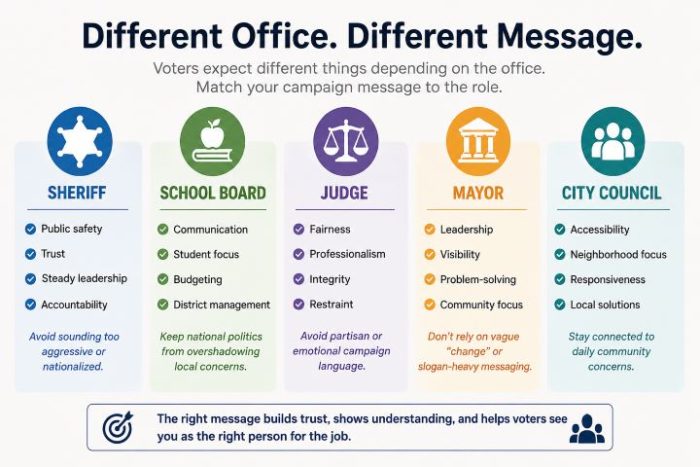
Quick Reference: Matching Message To Office
| Office | What Voters Usually Expect | Common Messaging Mistake |
|---|---|---|
| Sheriff | Public safety, trust, steady leadership | Sounding too aggressive or nationalized |
| School Board | Communication, student focus, budgeting | Letting national political fights overwhelm local concerns |
| Judge | Fairness, professionalism, restraint | Using partisan or emotional campaign language |
| Mayor | Leadership, visibility, problem-solving | Speaking in vague “change” language |
| City Council | Accessibility, neighborhood focus, responsiveness | Sounding disconnected from daily community concerns |
Sheriff Campaign Messaging Should Balance Strength With Trust
Sheriff candidates who only project toughness can miss what many voters also want: judgment, accountability, and community trust.
Local sheriff races often reward candidates who appear calm, experienced, and visible within the community. Messaging focused entirely on confrontation or national political rhetoric can feel disconnected from what voters expect from a sheriff’s office.
Part of that reaction comes from the role itself. Voters often view sheriffs as public-facing law enforcement leaders responsible for stability and public confidence, not simply political figures looking to energize supporters. Some law enforcement and sheriff candidates lean so heavily into aggressive language that they weaken the professionalism and stability they need to project. Voters often want reassurance as much as strength.
Messaging around public safety, leadership, accountability, experience, and community partnerships usually feels more grounded in the responsibilities of the office.
The same principle applies visually. Sheriff campaign websites often work best when the photography, slogans, and homepage messaging reinforce professionalism, trust, and leadership rather than outrage or conflict.
School Board Messaging Should Stay Local And Practical
School board candidates often perform best when they speak to district-level concerns before national political debates.
Education has become increasingly politicized nationally, but many voters still focus on practical concerns: communication, school quality, budgeting, student support, and district management.
Candidates for school board can run into trouble when their message becomes too broad or ideological while ignoring the everyday concerns parents are dealing with locally. That happens because many school board voters are evaluating candidates through the lens of communication and trust in local decision-making rather than party politics alone.
Messaging that emphasizes transparency, listening to parents, responsible budgeting, improving communication, and supporting students often feels more connected to the actual responsibilities of the position.
Visual presentation matters here as well. School board campaign websites usually benefit from approachable messaging, community-oriented photography, and issue sections that are practical and easy to understand.
Judicial Campaign Messaging Requires Restraint
Judicial candidates who campaign like partisan advocates can weaken the very credibility they need to build.
Many voters expect judges to project professionalism, fairness, ethics, and restraint. Aggressive political branding or emotionally charged rhetoric can feel out of place in judicial races, even when those tactics may work elsewhere.
Judicial campaigns are especially sensitive to tone. Materials that feel too political can make voters question the candidate’s temperament before they consider their qualifications. Voters often react this way because judges are expected to apply the law fairly and impartially. Campaign messaging that feels combative or highly ideological can conflict with those expectations, and some voters will notice.
Messaging that emphasizes qualifications, fairness, integrity, legal experience, and judicial temperament usually aligns more naturally with the office.
That same tone should carry into presentation and branding. Judicial campaign websites often work better with clean layouts, professional photography, restrained visuals, and credibility-focused homepage messaging.
Mayor And City Council Messaging Should Sound Connected To Daily Life
Local executive and council races usually reward candidates who sound accessible, specific, and visibly connected to community problems.
Voters often want to know whether the candidate understands local issues, is visible in the community, and can address practical concerns affecting daily life in a town or city. Messaging that focuses only on broad political themes can feel disconnected from the realities voters experience in their own neighborhoods.
For mayoral and city council candidates, vague or slogan-heavy messaging often fails because voters are looking for visible connection to local problems. They often respond better to practical concerns involving infrastructure, local services, regional development, and neighborhood quality of life.
That reaction is common in local government races because voters tend to judge these offices through direct personal experience. Roads, services, development, and neighborhood concerns affect people far more visibly than abstract political messaging or a focus on national issues. When national themes are brought into local politics, especially when it has nothing to do with the elected role, we have to wonder if that candidate will survive their primary or general election.
Specificity matters in local races. Mayor campaign websites and city council campaign pages often perform better when they include local imagery, neighborhood-focused messaging, visible contact information, and issue sections tied directly to community concerns.
Your Campaign Website Should Reflect The Office You’re Seeking
A campaign website should not just identify the candidate. It should show that the candidate understands the role they are asking voters to trust them with.
Your website copy, visuals, slogan, and candidate biography should all reinforce the same campaign identity based on the office you are running for.
A candidate website can lose credibility when the message feels disconnected from the race. A judicial candidate using aggressive branding or a school board candidate relying on vague national political language can unintentionally weaken voter confidence.
The strongest campaign websites make voters feel, within the first few seconds, that the candidate belongs in that office.

Campaign Messaging FAQ
What messaging works best for a sheriff candidate?
Sheriff campaign messaging should balance public safety with trust. Voters often want to see strength, but they also want judgment, accountability, and steady leadership.
What messaging works best for a school board candidate?
School board candidates usually benefit from practical, local messaging. Communication, student support, budgeting, and district-level concerns often matter more than broad national talking points.
How should a judicial candidate present their campaign?
Judicial candidates should use a restrained and professional tone. Messaging should emphasize qualifications, fairness, integrity, and temperament rather than aggressive political language.
Why should campaign messaging change by office?
Each office carries different responsibilities and voter expectations. A message that feels appropriate for a sheriff race may feel too aggressive for a judicial race, too narrow for a school board campaign, or too disconnected for a mayor or council race.
Final Thoughts
Before you settle on a slogan, homepage message, or campaign design, think about what voters expect from the office itself. A sheriff candidate, judicial candidate, school board candidate, and city council candidate should each project a different kind of leadership.
Look at how other political candidates have approached their sites before choosing a direction. The right tone can make your campaign feel more credible from the first visit.
Read More:

How Much Does a Political Campaign Website Cost? »
Tags: messaging, personal branding