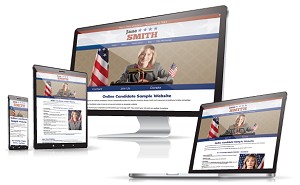
One problem with many local campaign websites has nothing to do with design.
It’s a lack of content.
We see this all the time. A candidate is ready to launch, but the campaign only has a short bio, a few lines about why they are running, and not much else. There may not be enough issue content, enough voter information, or enough detail to make the website feel complete. That’s also why it helps to think through what pages a campaign website should include.
Frequently asked questions are an easy way to add useful content without turning every page into a long policy write-up. They give you a place to answer voter concerns, explain your positions, and fill in gaps on pages that would otherwise feel thin.
We’ve worked with candidates who did not have enough material for full issue pages at the start, but did have enough recurring questions to build strong FAQ content. In many cases, that is what helps a website start feeling more complete.
Get Your Campaign Website in Place Early
Once your campaign gets underway, there will always be something more urgent to do. Setting up your website early gives you a place to introduce yourself, explain your positions, collect supporters, and accept donations when you are ready.
Online Candidate can build and set up your campaign website for you, or you can create your own with our Monthly Campaign Website Builder starting at $29/month.
For local races especially, that matters. Many voters are not going to spend much time on your website. They’re going to skim, look for a few answers, and make a quick judgment. If your website answers the right questions clearly, you are already ahead of many campaigns.
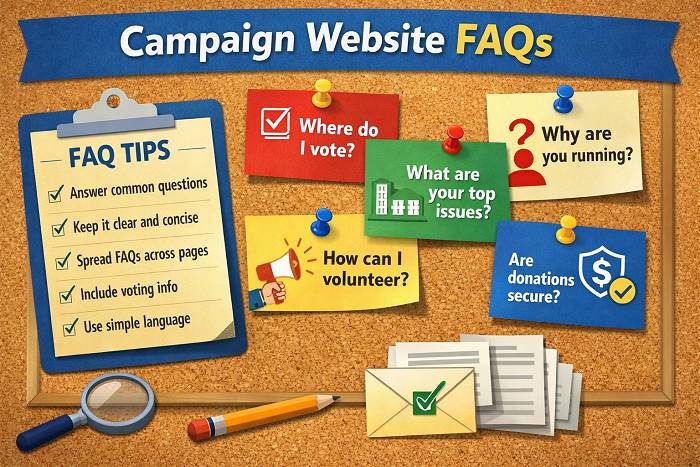
Why FAQs work on campaign websites
A strong FAQ section helps visitors find answers faster. It gives campaigns a place to address concerns directly. It also helps cover more of the questions voters actually have.
FAQ sections can help your campaign by:
- giving undecided voters quick answers
- adding depth to short issue pages
- answering practical questions about voting, volunteering, and donations
- helping campaigns respond to common concerns before they turn into bigger problems
- adding useful, searchable text
That last point matters. Many local candidate websites do not have enough written content to support search visibility or answer the kinds of questions voters type into Google. FAQs can help with both.
FAQs are especially useful for local candidates
Local campaigns usually do not start with much content.
A school board candidate may have strong reasons for running, but no long issue statements. A town board candidate may know the community well, but not have every position written out yet. A county clerk or comptroller candidate may need to explain what the office does before getting into why they are the right choice.
Instead of forcing the campaign to write long pages all at once, you can build useful material one question at a time.
This works well for websites of candidates running for school board, city council, town board, mayor, sheriff, district attorney, county clerk, state legislature, and Congress. The exact questions vary by office, but voters are still looking for the same thing: straightforward answers.
Sometimes the most important questions are not policy-heavy at all. People just want to know who the candidate is, why they are running, what they stand for, and whether they seem prepared for office.
Where FAQs should go on a candidate website
One mistake campaigns make is dumping every question onto one long FAQ page. In many cases, it works better to place questions where they naturally belong.
We also find that FAQ content usually works better when it is spread across the right pages instead of buried on one long list.
About page FAQs
This is a good place to answer questions such as:
- Why are you running for office?
- What experience do you bring to this role?
- How long have you lived in the community?
- What should voters know about your background?
Issue page FAQs
Issue pages are often the best place for FAQs tied to voter concerns.
Questions might include:
- What is your position on local development?
- How would you handle property taxes?
- What would you do about traffic in our town?
- What are your priorities for public safety?
- What is your view on school spending?
Voting information FAQs
This section is often overlooked, and it’s an important topic for all your supporters.
Questions here can include:
- Where do I vote?
- How do I register to vote?
- When is Election Day?
- Is early voting available?
- Can I vote by mail?
You can also point visitors to state voting information links for official deadlines and election resources.
Volunteer and donation FAQs
These pages should answer practical questions such as:
- How can I volunteer for the campaign?
- Do I need campaign experience?
- Where does my donation go?
- Is online giving secure?
- Can I donate by check?
A main FAQ page can still be useful, but it works best as a hub that points visitors to deeper pages.
Start with the questions people actually ask
The strongest FAQ sections usually come from the questions candidates hear in person, by email, and on social media.
Look at what the candidate hears at events. Review supporter emails. Check social media comments. Think about what volunteers, donors, and undecided voters tend to ask first.
We often see campaigns skip over questions that feel obvious to them because they have been living with the race for months. Voters have not, and many are just beginning to pay attention.
In many political races, the campaign already has the raw material. It is just scattered across emails, Facebook comments, conversations at events, and notes from people asking the same things over and over. This is similar to how voter questions shape a campaign long before a website is finished.
If the same question comes up more than once, it probably belongs on the website.
Candidates usually know more than they think they do. The challenge is pulling the right answers out in a format voters will actually read.
Better FAQ examples by office type
A lot of campaign FAQ examples sound too generic. The better ones sound like questions a real voter might actually ask.
School board candidate
Q: Why are you running for school board?
A: I’m running because families deserve a school board member who listens, communicates clearly, and stays focused on students. Our district needs stronger academic focus, more budget transparency, and better communication between the board and the people it serves.
Q: What are your top priorities for the district?
A: My priorities are academic performance, budget accountability, and clear communication with parents and residents. I want to see stronger support for students and teachers, along with more transparency around major district decisions.
City council or town board candidate
Q: What would you do about overdevelopment in town?
A: Growth should be planned carefully and should reflect the needs of residents, not just the interests of developers. I support smart development, but not at the expense of traffic, infrastructure, neighborhood character, or quality of life.
Q: How would you approach rising local taxes?
A: I want our local government to take a harder look at spending before asking residents to pay more. That means better oversight, more transparency, and clearer priorities.
Mayor candidate
Q: Why do you want to be mayor?
A: I want to bring a more practical, visible style of leadership to city government. Residents want a mayor who shows up, responds, and pays attention to the basics: public safety, roads, services, and the overall direction of the city.
Sheriff candidate
Q: What experience prepares you for this position?
A: My background includes law enforcement experience and leadership responsibilities that relate directly to the demands of this office. I understand the importance of training, supervision, public safety coordination, and maintaining confidence in the department.
State legislature candidate
Q: How will you represent this district?
A: The job is to represent the district well, stay visible, and make sure local concerns are not lost at the state level. That means listening, communicating consistently, and staying focused on the people who sent you there.
Answer difficult questions directly
One of the smartest uses of a FAQ section is dealing with tough questions before voters start filling in the blanks themselves.
Don’t dodge obvious issues. Don’t answer a fair question with vague filler. If a subject is sensitive, address it clearly and calmly.
For example:
Weak answer:
“I understand there are many perspectives on this issue, and I look forward to working with stakeholders toward a solution.”
Better answer:
“I support careful local development, but not every project is the right fit. Growth should improve life for residents, not add strain to traffic, services, or neighborhood stability.”
The second answer sounds like a position. That is what voters are looking for.
This is also where simple language in politics helps. Clearer language makes it harder to hide behind vague answers.
Common FAQ mistakes
We see a few problems come up again and again.
- answers that say very little or are incomplete
- treating the FAQ page as a substitute for all other content
- adding too many weak questions
- repeating the same answer across the site
- ignoring practical questions about voting, volunteering, or donations
- leaving the page outdated
One mistake we see a lot is answering the question the campaign wants to answer instead of the question a voter is really asking.
We also see campaigns bury good FAQ material on a single page when some of those questions really belong on the about page, issues page, or donation page.
A shorter list of strong questions is better than a long list of bland ones.
Do candidate website FAQs help with SEO?
They can, if they are written naturally and placed in the right spots.
A useful FAQ section can support search visibility by adding relevant content around the candidate’s name, office sought, district, issues, and voter concerns. It can also help capture longer search phrasing, especially when people search in question form.
You do not want to load the page up with keyword-heavy questions just for search engines. You want to build a candidate website that answers real questions clearly. That usually makes the page more useful, and it often helps search visibility as well.
For the broader version, see SEO tips for campaign websites.
To FAQ or not FAQ?
A FAQ section is a simple way to make your campaign website more useful and more complete.
Many voters are not looking for long policy documents. They are looking for quick, trustworthy answers that help them decide whether you seem prepared, serious, and worth supporting.
If your campaign website feels thin, unclear, or unfinished, improving your FAQ content is a smart place to start.
Need help writing or revising your candidate website content? Online Candidate provides political campaign website services built for real campaigns, and we also offer copy examples and copy editing services for website clients.
Read More:


Spring Cleaning For Your Campaign’s Social Media »
Tags: local campaigns, personal branding