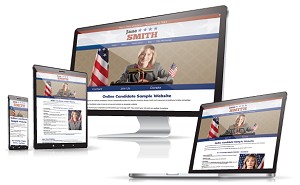
“Everybody’s on Facebook. I can just run my online campaign through my Facebook Page.”
We’ve heard that idea before.
Bottom line: Running a political campaign through social media alone is not a strategy. It’s a dangerous dependency. A Facebook Page can support your campaign, but it should not replace your official political campaign website.
At Online Candidate, we’ve seen candidates make this mistake. They promote the Facebook Page, print it on campaign materials, post updates there, and assume voters will keep up. Then they discover that social reach is very limited and hard to control.
These days, social media is important for political campaigns in creating an online presence and building support. Facebook, Instagram, TikTok, YouTube, X, and other platforms can all help candidates reach voters in different ways. Facebook provides tools for candidates to promote events, share video, post updates, stream live events and build awareness. Meta’s advertising system can also help campaigns reach targeted audiences, but political advertisers must follow the platform’s current authorization, disclaimer, and ad policy rules.
Get Your Campaign Website in Place Early
Once your campaign gets underway, there will always be something more urgent to do. Setting up your website early gives you a place to introduce yourself, explain your positions, collect supporters, and accept donations when you are ready.
Online Candidate can build and set up your campaign website for you, or you can create your own with our Monthly Campaign Website Builder starting at $29/month.
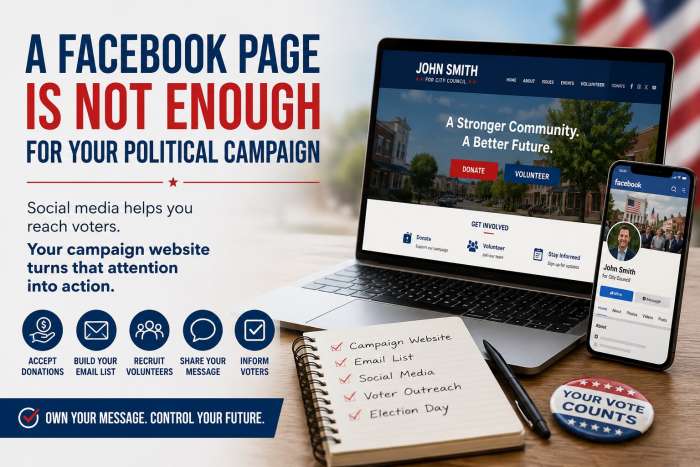
However, a social media profile is not a substitute for a real home on the web. Social media does not provide the features that a campaign website provides. For example, websites convert better for important tasks such as email signups and accepting online donations.
Facebook may be the most common example, but the same issue applies to Instagram, TikTok, X, YouTube, LinkedIn, Threads, and any other third-party platform. These platforms are useful outreach channels. They should not be your campaign headquarters.
If that’s not enough, here are a few other reasons why Facebook alone should not be the hub of your online campaign:
Not all voters are on Facebook
Believe it or not, there are people who do not use Facebook, and there are others who refuse to use Facebook due to privacy concerns. If you operate your digital operations entirely within Facebook, then you’re placing your campaign behind a wall. If someone comes to your page and wants to interact, they’ll need a Facebook account to do so.
If it’s a potential donor you turned away, that can cost you money. If it’s a potential supporter, that could cost you a vote.
The same problem exists across other platforms. Not every voter uses Instagram, watches TikTok, or follows political discussion on X. Your official campaign website gives everyone the same place to find your message, donation page, volunteer form, and voter information.

Facebook is a ‘pay to play’ platform
A regular Facebook Page post will usually reach only a fraction of your followers. Because of the Facebook post algorithm, many of your fans won’t see your posts after they ‘Like’ your page. The exact percentage changes over time, but the larger point does not: organic reach is limited and unpredictable.
We’ve had candidates ask why their Facebook posts are not reaching more people. In many cases, the answer is simple: liking a Page does not mean someone will see every update. Without engagement or paid promotion, campaign posts may reach only a small part of the audience.
That is, unless you pay to promote your post. In that case, your update will reach many more people.
Even then, targeting matters in reach and cost. We’ve seen campaigns struggle when ads are aimed too broadly. A local campaign does not need to reach everyone in a county, state, or media market. It needs to reach the right voters in the right district with the right message.
A campaign website gives those ads a better destination than a general Facebook Page. Instead of sending voters back into a feed, you can send them to a donation page, volunteer signup form, issue page, or voter information page.
Of course, if you want to reach more people the next time you post, you will need to pay again … and again … and again.
For many campaigns, this can eat up a lot of advertising dollars. For those with limited budgets, it’s best to promote only important news, specific fundraising posts, and get-out-the-vote reminders before Election Day.
If you want to keep supporters up to date, an email list or SMS program can provide more reliable reach.
Social media can help you find supporters. Your website, email list, and SMS program help you keep them.
You don’t control the platform
Your Facebook page ultimately operates under the terms and conditions of Facebook. If the rules on Facebook change, you’ll have no choice but to accept those changes. If someone reports your page, post or even your advertising for ‘bad behavior’, valid or not, there is little you can do if Facebook takes action. You don’t own your space on Facebook. What Facebook gives, Facebook can take away if it decides that you have broken its terms of service.
This isn’t just a Facebook problem. Every major social platform controls its own rules, algorithms, verification requirements, political ad policies, moderation systems, and account restrictions. A campaign can lose reach, lose access, or have content limited at the worst possible time.
You also don’t control the full voter experience. The platform controls the layout, recommendations, comments, notifications, and what voters may see before or after they interact with your content.
Knowing that, do you really want to base your entire online presence on a platform that you do not control?
Social media is outreach, not your campaign headquarters
Social media platforms all have campaign value. Each one can support a different part of your online strategy.
Facebook may help with local awareness, events, community visibility, and older voters. Instagram and TikTok can showcase short video, campaign visuals, and behind-the-scenes content. YouTube can host longer videos that can be embedded on your website. X may help with journalists, activists, and political observers. LinkedIn can reinforce professional credibility.
But none of these platforms should replace your campaign website.
Your website is where voters should find your biography, issues, endorsements, donation link, volunteer form, contact information, press materials, disclaimers, and voter information. Social media should point people back to those assets. It should not be the only place those assets exist.
Your campaign website gives you control
Now, don’t take all this the wrong way. Facebook is a great tool for politicians and campaigns to gather new supporters and reach voters. The same is true for other social media platforms when they match your audience and campaign goals. When you have both a campaign website and a Facebook Page, both can appear in search results. Filling the search results with listings that you largely control is a smart strategy for online reputation management.
A campaign website also gives you one official source for your message. Voters, donors, volunteers, reporters, and endorsing organizations can all be sent to the same place.
Social posts disappear quickly in a feed, and they are lost and quickly forgotten. Campaign website pages remains organized, searchable, and easy to reference. This matters for local campaigns, where a small budget has to reach a specific district, ward, town, city, or county.
Integrating social media into your website and posting items from your site to social media is the best approach to online campaigning. That way you can reach your followers no matter where they are.
To paraphrase a common expression, “Don’t build your campaign on someone else’s land.”
In the end, you should have control over your medium and your message. That starts with having your own domain name and political campaign website.
Related: Facebook Tips for Political Campaigns
Read More:


How To Launch Your Political Campaign Website »
Tags: facebook